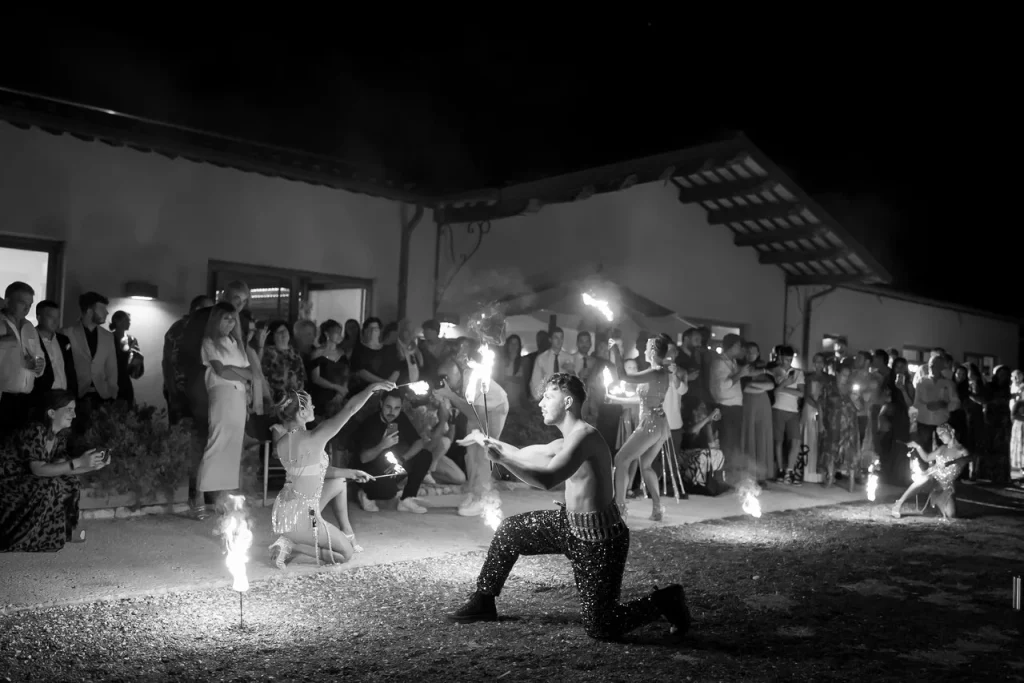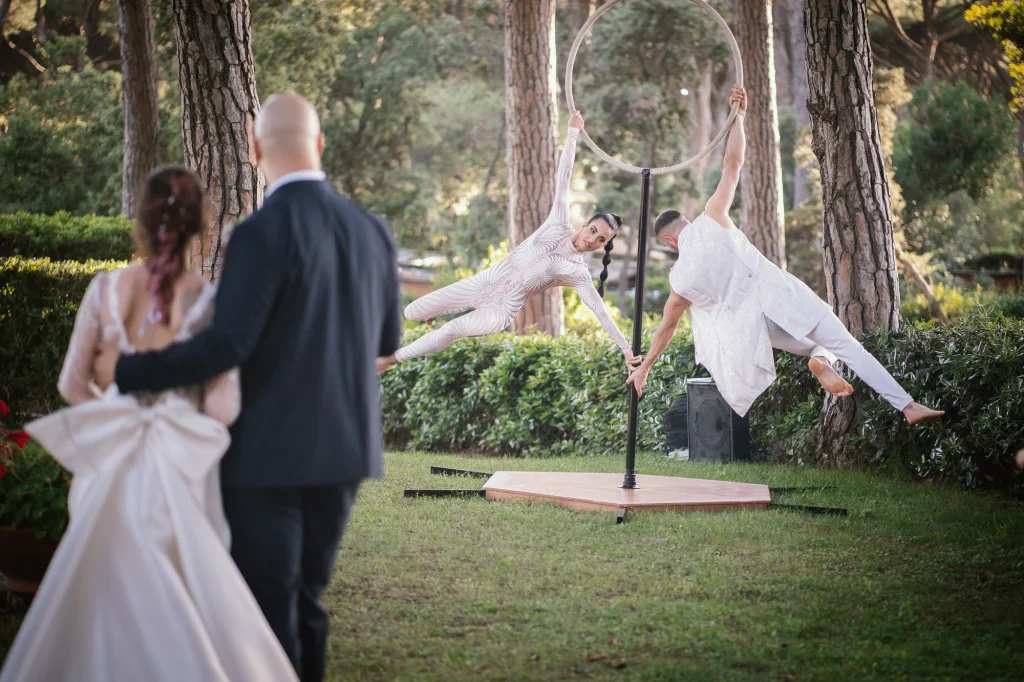
A fire show can be part of a wedding, a corporate dinner or a private party. But to get a great result you need to choose the right moment, assess the space and understand which type of performance best suits the event.
After years of performing in very different venues, we have put together ten practical tips to help you organise a Fire Show and avoid some of the most common mistakes.
1. Choose the right moment for the show
The moment you place a show in the programme can make a big difference.
At weddings we often recommend scheduling it before the cake cutting. Guests gather in a dedicated area, enjoy the performance and then move on to one of the main moments of the evening.
At corporate events, the show can instead be placed between dinner and the after-dinner party, or at a special moment in the programme.
There is no perfect time for everyone. What matters is that the performance does not interrupt something the guests are already doing, such as dining or chatting.
2. Don’t make it longer than it needs to be
A fire show doesn’t have to last half an hour to be engaging.
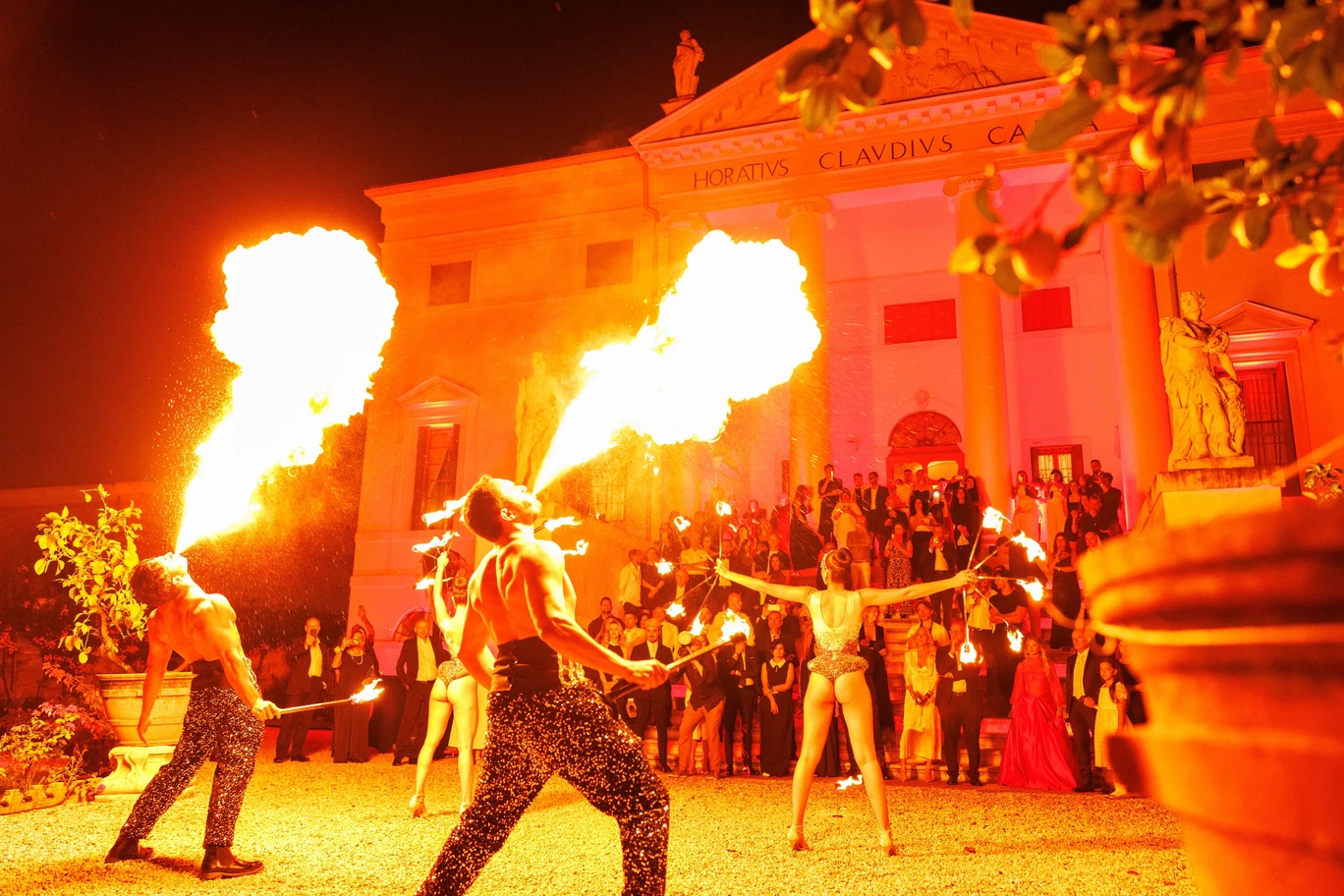
In our experience, around 15 minutes is often the ideal length. It is enough time to alternate choreography, scenic effects and moments of greater intensity, while keeping the audience’s attention high.
Our productions generally last between 10 and 20 minutes, depending on the chosen set-up.
Roaming fire welcome performances are a different matter: they can accompany the guests’ arrival for longer, up to around 30 minutes.
3. Assess the venue before choosing the show
One of the first things we ask when we receive an enquiry is where the event will take place.
Knowing whether the venue has a garden or a terrace is not enough. We need to understand how much space can actually be used, how the guests will be arranged and whether there are structures, decorations or suspended elements.
That is why we ask for photos, videos and, when available, floor plans.
Sometimes it is enough to adjust a choreography or use different equipment to adapt the show. Other times certain effects have to be left out.
The venue should be assessed before the artistic set-up is confirmed, not when the performers have already arrived on site.
4. The number of performers changes the impact of the show
One of the most frequent questions is about the number of performers: two, four or eight artists?
In general, more performers make for a richer, more spectacular show. Group choreographies can be developed, larger visual compositions created and different effects used at the same time. The difference shows, especially in large spaces.
This does not mean, however, that a large cast is always needed.
In some venues the available space makes it preferable to work with two performers. In other cases it is the budget that points towards a smaller set-up.
That is why we offer shows with different numbers of performers, adapting choreography, equipment and effects to the situation.
More performers mean more scenic possibilities; with fewer performers we can still deliver a complete, polished and engaging show. The performers’ training and our attention to quality remain the same.
5. Look at the choreography, not just the flames
When you watch a video of a fire show, try to notice what happens between one effect and the next.
Do the performers move in a coordinated way? Do the sequences follow the music? Is the show built as a whole, or does each performer simply do their own act?
These are important differences.
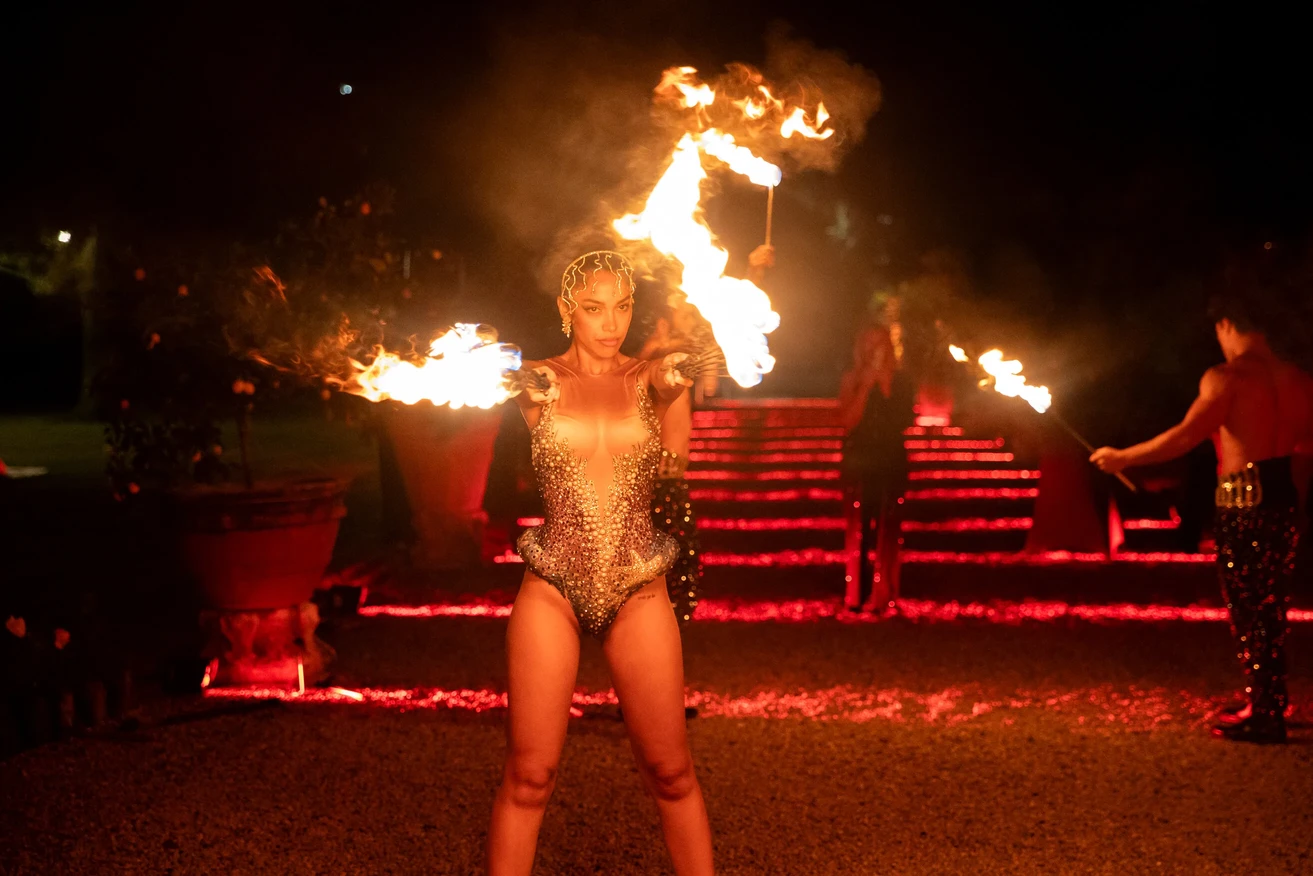
In our productions, fire is one element of the performance, together with dance, choreography, costumes and music.
A well-built show does not need to use the biggest effects all the time. Even the simplest sequences can work very well when they are performed with precision and placed at the right moment.
6. Don’t underestimate the choice of music
Music sets much of the rhythm of a show.
A production with epic atmospheres will be very different from an elegant performance built on softer movements and less aggressive choreography.
Over time we have developed several musical and scenic formats, including Italian-themed productions and shows dedicated to special occasions, such as Halloween.
We have ready-made choreographic sequences that we can adapt to the needs of the event.
This lets us change the musical and artistic structure without improvising a show from scratch every time.
7. Choose effects based on the available space
Not every fire effect can be used in every venue.
Fans, fire poi, juggling, fire eating, acrobatic fire breathing and scenic effects all have different characteristics and requirements.
For example, a fan sequence can suit an elegant choreography, while effects with vertical flames require specific conditions and suitable spaces.
In some productions we also use cold sparks and additional scenic effects, when the technical conditions allow it.
Our advice is simple: don’t choose a show just because you saw a particularly impressive effect in a video.
First you need to check that the effect is suitable for the venue and can be performed safely.
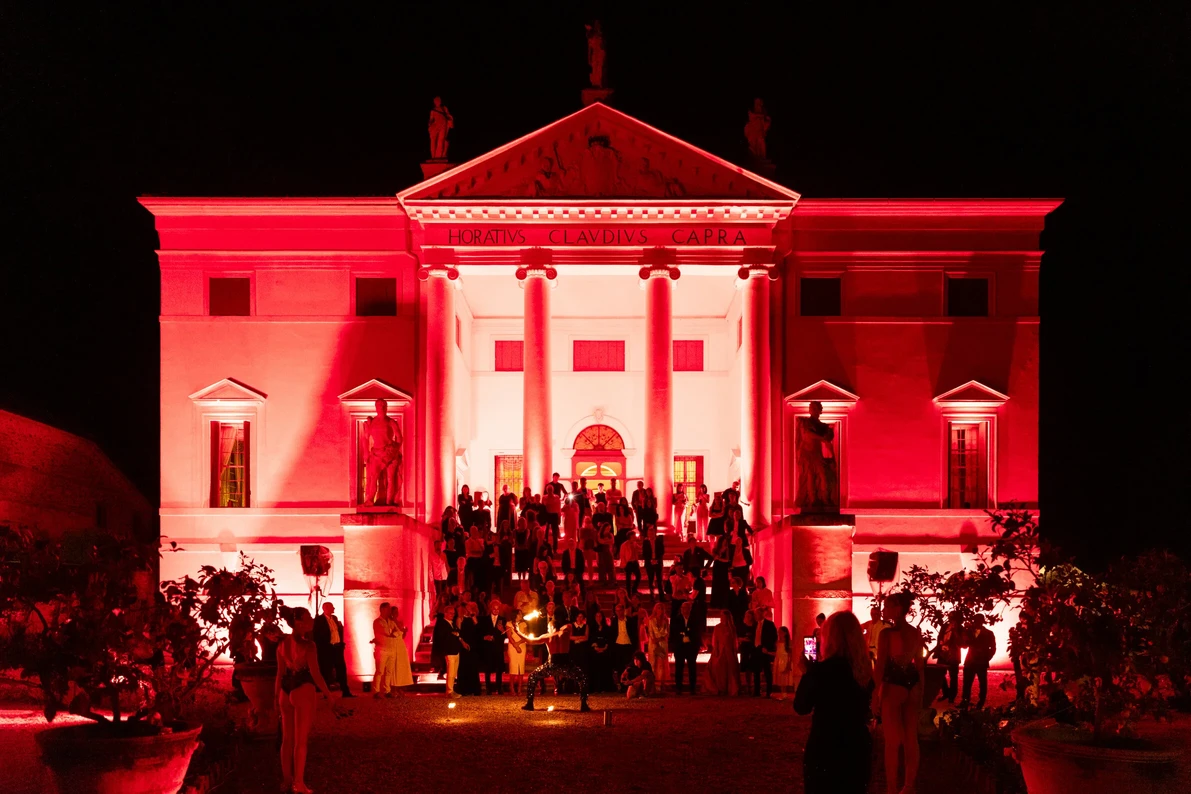
8. Don’t rule out indoor spaces
When people think of fire shows, they almost always picture outdoor spaces.
In fact, under certain conditions fire performances can also be considered indoors, but not all equipment and sequences are suitable for this use.
In some settings, for example, a performance limited to controlled effects such as fire eating can be designed.
Feasibility depends on the characteristics of the space, the set-up, the fire safety measures and any permits that may be required.
That is why we never confirm an indoor production without first checking the technical and safety conditions.
9. Plan what to do in case of bad weather
If the show takes place outdoors, weather conditions must be considered from the planning stage.
Wind can affect the equipment and the effects used. Rain can make the performance impossible.
There is no single solution for every situation: depending on the conditions, some sequences can be modified, while in other cases the show has to be suspended.
When possible, we recommend considering an artistic alternative in advance. For example, an Acro Duo or aerial dance performance, as long as it suits the spaces and conditions of the venue.
Any cancellation or replacement arrangements should be agreed before the event and included in the contract.
10. Choose who designs the show, not just who performs it
A fire show may last fifteen minutes, but the work needed to create it begins long before.
The spaces need to be assessed, the number of performers chosen, choreography and music defined, the usable effects identified and everything coordinated with the event organisers.
At BGlare we work with multidisciplinary performers, trained in-house and used to performing coordinated productions.
This allows us to adapt ready-made shows and sequences to different situations, while keeping a consistent artistic direction.
Our final advice is therefore not to stop at the price or the number of performers stated in a quote.
Ask how the show will be built, which checks will be carried out and how the venue’s requirements will be handled.
These are the aspects that make the difference between booking a performance and organising a show that is right for your event.
Planning a fire show for your event?
Every event is different. That is why, before proposing a production, we assess the venue, the programme and the type of show you want to create.
You can see photos, videos and some of our productions on the dedicated BGlare Performers Fire Shows page, or contact us for a tailored proposal.